

Published on: Mar 1, 2025
by: Velocity Capital
Conflict-Free Replicated Data Types (CRDTs): A Guide to Modern Distributed Systems
In the ever-evolving landscape of distributed systems, ensuring consistent data across geographically separated nodes has become a critical challenge. Real-time collaboration, decentralized applications, and fault-tolerant infrastructures demand solutions that can gracefully handle concurrency without introducing bottlenecks. Traditional synchronization methods—such as strict locking or consensus protocols—can guarantee consistency, but at the cost of system performance, latency, and scalability.
Conflict-Free Replicated Data Types (CRDTs) present a novel and efficient solution by enabling optimistic replication. Instead of coordinating every change through centralized locks or voting protocols, CRDTs allow multiple users or nodes to update data concurrently. These updates eventually converge to the same final state across all replicas without requiring explicit conflict resolution from developers or users.
CRDTs are now an essential tool for a wide range of applications: collaborative tools like Figma and Trello, geo-distributed and decentralized databases, edge computing and IoT systems, as well as blockchain and peer-to-peer platforms. Their design embeds conflict resolution logic within the data types themselves, enabling smooth synchronization even under network partitioning or delayed communication.
How CRDTs Work: Principles and Types
CRDTs guarantee eventual consistency, meaning that even when updates are made independently and in parallel across replicas, the system will ultimately converge to a consistent state once all updates are delivered. This is possible because CRDTs rely on operations that are inherently commutative, associative, and idempotent—ensuring that order and duplication of messages do not compromise correctness.
There are two main categories of CRDTs:
- State-based CRDTs (CvRDTs): Each replica periodically shares its entire state with others. Upon receiving a state from another node, it merges the two using a mathematically defined "join" operation. This operation is based on a join-semilattice, a partially ordered set where each pair of elements has a least upper bound. A classic example is the G-Counter, a grow-only counter where each replica independently increments its value, and merging takes the maximum from each.
- Operation-based CRDTs (CmRDTs): Here, only the operations (not the entire state) are broadcast to all replicas. These operations must be both commutative and idempotent and are typically applied in the order defined by causal relationships. A common example is the PN-Counter, which tracks both increments and decrements, ensuring correct totals despite the operation order.
A middle-ground approach, Delta-based CRDTs (Δ-CRDTs), reduces bandwidth by transmitting only the incremental changes (called deltas) rather than full state or full operation logs. These deltas are still designed to guarantee convergence using the same mathematical principles.
Mathematical Foundations and Convergence Guarantees
CRDTs rely heavily on formal structures like join-semilattices to ensure correctness. These structures define how states can be safely merged without coordination. The key properties required are:
- Commutativity: The result is the same regardless of the merge order.
- Associativity: Grouping of merge operations doesn’t affect the final state.
- Idempotence: Merging a state with itself yields the same state.
Together, these properties guarantee that replicated data will eventually converge, even in highly asynchronous or partitioned environments.
Causality and Conflict Resolution
Concurrency is central to distributed systems. CRDTs use tools like vector clocks, hybrid logical clocks, or timestamps to track causal relationships between updates. This information helps systems decide how to resolve conflicting updates. For instance:
- In a Last-Writer-Wins register, the value with the latest timestamp is chosen.
- In add-wins sets, concurrent adds and removes favor retention of the element.
- In remove-wins sets, removals take precedence in concurrent operations.
Such policies are crucial when operations like add(x) and remove(x) occur concurrently on different replicas.
Common CRDT Data Structures
- Registers: Hold a single value, with semantics like last-writer-wins or multi-value (preserving all concurrent writes).
- Counters: G-Counters (increment-only) and PN-Counters (support increment and decrement), using local contributions that merge safely.
- Sets: Add-wins, remove-wins, and LWW sets, all using unique tags or timestamps to manage element presence.
- Maps: Complex CRDTs where keys may map to embedded CRDTs. Merge semantics may follow strategies like remove-as-reset, update-wins, or remove-wins.
These structures are customized to handle application-specific requirements for consistency and resolution.
Replication and Synchronization in Systems
At the systems level, CRDTs require robust replication mechanisms to propagate state or operations between nodes. While state-based CRDTs only need to ensure eventual connectivity, operation-based CRDTs typically require reliable causal broadcast.
Several replication techniques are employed:
- Gossip protocols: Periodic, randomized state exchange to guarantee eventual consistency.
- Reliable multicast or pub-sub systems: Ensuring delivery of all operations to all subscribers.
- Delta-based propagation: Only sending minimal changes (deltas) to save bandwidth.
Merkle-CRDTs: The Synthesis of Merkle-DAGs and CRDTs for Causally-Consistent P2P Systems
In distributed systems, one of the fundamental design challenges is maintaining consistency across replicas despite unreliable networks, partitions, or offline operation. Conflict-Free Replicated Data Types (CRDTs) and Merkle-DAGs individually address core aspects of this challenge—CRDTs provide conflict-free, eventually consistent data replication, while Merkle-DAGs offer content-addressable, verifiable data storage. Together, they form Merkle-CRDTs: a powerful abstraction enabling causally consistent peer-to-peer systems without global consensus or reliable delivery guarantees.
Combining CRDTs and Merkle-DAGs
CRDTs rely on algebraic properties to ensure convergence across replicas, assuming that updates will eventually propagate. Merkle-DAGs, used in systems like Git, IPFS, and blockchains, represent data immutably with hash-linked nodes, allowing for self-verification and efficient content sharing.
Merkle-CRDTs blend these ideas by embedding CRDT operations as payloads inside Merkle-DAG nodes. This transforms the DAG into both a causal history tracker and a delivery mechanism. Instead of assuming reliable broadcast, each node can traverse the DAG to gather missing updates, making Merkle-CRDTs ideal for decentralized and intermittently connected systems.
Merkle-Clocks: DAGs as Logical Clocks
Traditional CRDTs use vector clocks or version vectors to track causality. These mechanisms, however, become difficult to scale in dynamic or large networks. Merkle-CRDTs solve this by using Merkle-DAGs as logical clocks—each new operation is a node linked to its causal predecessors. This approach encodes the happens-before relationship naturally in the graph structure.
Merging clocks becomes equivalent to graph union, and conflict resolution can be inferred through graph traversal. Each replica independently maintains its own Merkle-Clock and can synchronize with others by exchanging only root content identifiers (CIDs), minimizing overhead.
Embedding CRDT Payloads
In a Merkle-CRDT, each DAG node carries a CRDT payload—this could be a full state, an operation, or a delta (partial update). Because the DAG already preserves causal structure and guarantees immutability, additional mechanisms for ordering or duplication are unnecessary.
This design brings several advantages:
- Per-object causal consistency by default
- Efficient anti-entropy via graph traversal
- No reliance on reliable transport protocols
Operation-based CRDTs benefit most, as they no longer require causally ordered delivery. Each operation becomes a node in the DAG, and the traversal order ensures correctness.
System Architecture: Syncer and Broadcaster
Merkle-CRDT systems are built around two key modules:
- DAG-Syncer: Given a CID, fetches and reconstructs the DAG from the network. This enables partial, on-demand sync without redundant transfers.
- Broadcaster: Announces root CIDs (new updates) to the network. Delivery is not guaranteed—missing updates can always be fetched later using the DAG-Syncer.
This architecture is transport-agnostic: systems may use IPFS, DHTs, or custom pub-sub protocols without impacting the CRDT semantics. It suits environments like mobile or IoT where continuous connectivity cannot be assumed.
Anti-Entropy and Efficient Sync
Anti-entropy in Merkle-CRDTs is intuitive. A replica broadcasts its root CID. Peers compare their local DAG and identify missing nodes by examining the ancestry. These nodes are fetched via the DAG-Syncer. Because DAGs are append-only and content-addressed, updates are immutable and deduplicated by default.
This ensures efficient and secure synchronization—even in adversarial networks, data remains verifiable and complete.
Support for Different CRDT Models
Merkle-CRDTs are compatible with various CRDT types:
- Operation-based: Ideal fit. Each operation is its own node.
- State-based: Feasible, but can be inefficient due to larger payloads.
- Delta-based: Efficient in low-bandwidth environments, embedding only minimal state changes.
Because the Merkle-DAG handles causality, there's no need for metadata-heavy clocks or reliable transport—making delta updates especially practical.
CRDTs Vs Blockchains
Feature | CRDTs | Blockchains |
| Conflict Resolution | Automatic | Consensus-based
|
| Performance | High | Slower (due to consensus) |
| Network Partition Tolerance | High | Moderate |
| Decentralization | Yes | Yes (with consensus overhead)
|
| Suitability for Collaborative Apps | Excellent | Good |
CRDTs in Emerging Protocols and Projects
CRDTs are not just theoretical constructs; they are actively shaping next-generation distributed systems, decentralized applications, and real-time collaboration frameworks. Various projects integrate CRDTs with other cutting-edge technologies such as hashgraphs, decentralized memory systems, and gossip-based synchronization to enhance scalability, performance, and fault tolerance. Their ability to handle concurrency, tolerate network partitions, and guarantee eventual consistency without coordination has led to widespread adoption across real-time collaboration tools, decentralized applications, and peer-to-peer databases.
In this section, we explore prominent CRDT-powered protocols and projects, including Topology, Farcaster, DefraDB, Delta Network, OrbitDB, and IPFS Collaborative Editing. Each demonstrates how CRDTs enable efficient, conflict-free, and decentralized data synchronization in different domains.
Project 1 - Topology Protocol
CRDTs (Conflict-Free Replicated Data Types) provide a robust approach to managing data in distributed systems by allowing multiple users to update shared data simultaneously without conflicts. Unlike traditional databases that rely on strict locking or consensus mechanisms, CRDTs ensure eventual consistency by enabling independent updates that automatically merge over time. This makes them particularly useful in geo-distributed databases, collaborative applications (e.g., Google Docs), and decentralized systems where real-time synchronization is essential. Moreover, CRDTs inherently exhibit **Byzantine Fault Tolerance (BFT)**—ensuring that even if some nodes fail, go offline, or act maliciously, the system remains operational and converges to a consistent state. This fault tolerance, combined with their ability to function without global coordination, makes CRDTs a fundamental building block for scalable and resilient distributed architectures.
Expanding on CRDTs, the Distributed Real-Time Program (DRP) protocol integrates CRDT principles with Hashgraph technology to enable real-time, decentralized computation. While blockchain networks ensure sovereignty through global consensus, they suffer from latency constraints and high coordination costs. DRP addresses this by allowing independent, concurrent execution of operations, eliminating the need for strict ordering at every step. This makes it an ideal protocol for real-time decentralized applications, multiplayer gaming, and social networks that demand low latency and high scalability. Unlike blockchain-based Layer 2 solutions, DRP is an open Internet protocol, aiming for broader adoption beyond Web3 by redefining how decentralized computation functions across modern networks. With widespread adoption, DRP could serve as a foundational protocol for real-time, fault-tolerant applications that operate independently of traditional consensus mechanisms.
Topology Protocol and the Power of CRDTs, Hashgraphs, and Decentralized Real-Time Execution
As decentralized computing continues to evolve, protocols like Topology and DRP (Distributed Real-Time Program) are reshaping how real-time, distributed systems function without the limitations of traditional blockchain consensus. Topology Protocol leverages Conflict-Free Replicated Data Types (CRDTs), hashgraphs, and decentralized random access memory (dRAM) to provide a scalable, low-latency alternative for real-time applications. Unlike blockchains, which require global state coordination, Topology operates on a lock-free, concurrency-driven model, allowing decentralized applications (dApps) to function without costly synchronization bottlenecks.
How Topology Uses CRDTs for Decentralized State Management
CRDTs are a key foundation of Topology Protocol, enabling real-time, conflict-free updates across distributed nodes. Unlike traditional blockchain architectures that rely on strict transaction ordering through consensus, CRDTs allow nodes to update state independently and later reconcile differences without coordination overhead. This approach ensures that all replicas eventually converge to the same state, eliminating the need for costly validation steps like Proof of Work (PoW) or Proof of Stake (PoS).
In Topology Protocol, Conflict-Free Replicated Objects (CROs) function as composable, programmable entities that store and update data in a decentralized manner. CROs:
- Use CRDT-based state management, ensuring updates can be applied without conflicts.
- Are inherently fault-tolerant, meaning even if nodes operate asynchronously, their states will merge seamlessly.
- Enable local-first execution, reducing reliance on external validators or intermediaries.
For example, in a decentralized social media application built on Topology, user interactions such as likes, comments, or follows do not need global agreement before being processed. Instead, each node maintains local replicas of user activity, which eventually merge across the network without inconsistencies.
Hashgraphs and Causal Ordering in Topology Protocol
Alongside CRDTs, hashgraphs play a crucial role in Topology Protocol’s design, ensuring efficient and fair event ordering. A hashgraph is a DAG (Directed Acyclic Graph) that records transactions and their causal dependencies, allowing nodes to process events independently while preserving consistency.
Instead of relying on traditional blockchain consensus, Topology Protocol uses a hashgraph structure to enforce causal ordering in a Byzantine Fault Tolerant (BFT) manner. This approach ensures that:
- Operations are ordered fairly, preventing manipulation by miners or validators.
- Network latency does not affect state updates, as transactions do not need to pause for global synchronization.
- Sybil attacks are mitigated, since operations are recorded transparently across nodes in a tamper-resistant way.
A key benefit of using hashgraphs over blockchains is that nodes do not need to compete to validate transactions, eliminating the inefficiencies of mining or staking. By allowing concurrent updates and eventual agreement, hashgraphs provide a lightweight yet robust solution for fair ordering and real-time execution.
Decentralized RAM (dRAM): The New Memory Layer for Real-Time dApps
One of Topology Protocol’s most innovative contributions is its concept of Decentralized Random Access Memory (dRAM). Unlike blockchain-based storage models that operate like a hard drive, dRAM enables ephemeral, high-speed state updates that function more like computer RAM.
- Real-time execution: dRAM stores CRO states locally, allowing instant access without waiting for global consensus.
- Scalability: By keeping recent data at the edge, dRAM reduces bandwidth and storage requirements for nodes.
- Fault tolerance: Even if some nodes drop offline, others maintain the system’s integrity without disruption.
This decentralized memory model allows dApps to achieve near-instant state updates, making it ideal for applications like multiplayer gaming, decentralized AI coordination, and collaborative metaverse environments.
The Benefits of CRDTs, Hashgraphs, and Topology’s Unique Approach
By combining CRDTs, hashgraphs, and dRAM, Topology Protocol achieves a breakthrough in decentralized computing, offering:
- Scalability Beyond Blockchains: Unlike blockchain-based execution models, Topology allows for real-time, parallel processing without throughput bottlenecks.
- Censorship Resistance: CRDT-based updates prevent any single party from blocking transactions or enforcing arbitrary rules.
- Low-Cost Transactions: Since there’s no need for PoW or PoS validation, operations occur at negligible costs compared to gas-intensive blockchain networks.
- High Fault Tolerance: Even if most of the network is compromised, as long as a subset of honest nodes remains connected, the system continues to function correctly.
Conclusion
Topology Protocol represents a fundamental shift in decentralized computing, moving away from blockchain’s rigid consensus models toward a real-time, event-driven architecture. By utilizing CRDTs for conflict-free state replication, hashgraphs for fair and efficient ordering, and dRAM for decentralized memory management, Topology enables the next generation of decentralized applications.
This paradigm is especially powerful for use cases requiring instant interactions, such as decentralized gaming, real-time collaboration, metaverse infrastructure, and AI-driven automation. By eliminating traditional consensus bottlenecks, Topology paves the way for a more fluid, scalable, and autonomous decentralized computing ecosystem.
Project 2 - Farcaster
Farcaster: A Decentralized Social Network with Deltagraph Consensus, CRDTs & Gossip-Based Synchronization
Farcaster is a sufficiently decentralized social network that ensures user control over data and interactions while maintaining scalability. Unlike centralized platforms where data flow is controlled by a single entity, Farcaster distributes user-generated content across peer-to-peer (P2P) Hubs, leveraging Ethereum (Optimism) for security-critical functions while utilizing Conflict-free Replicated Data Types (CRDTs) and a gossip-based synchronization protocol for off-chain scalability.
This hybrid model avoids the inefficiencies of blockchain-based consensus while ensuring eventual consistency across the network. The core innovation behind Farcaster is the deltagraph, a data structure that organizes social interactions into a graph-based CRDT, enabling fast, decentralized synchronization without the need for global transaction ordering.
Technical Architecture: On-Chain Security & Off-Chain Scalability
Farcaster’s architecture consists of on-chain smart contracts for identity and key management, and off-chain Hubs for content storage and replication.
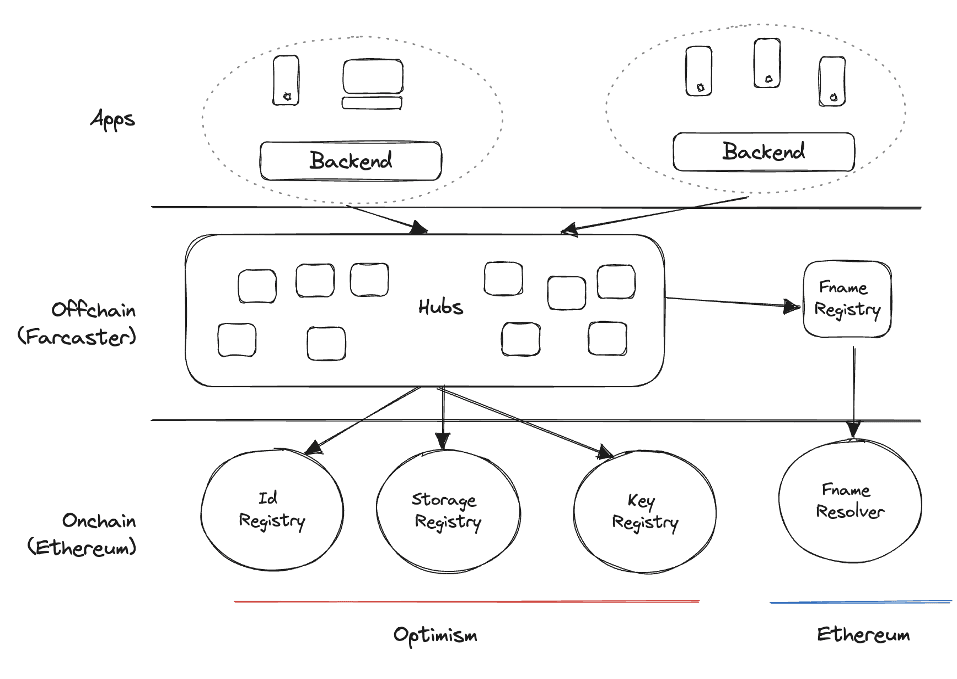
On-Chain Components (Ethereum & Optimism)
- ID Registry: Maps Ethereum addresses to Farcaster IDs (FIDs), allowing users to register and manage their digital identity securely.
- Storage Registry: Maintains records of allocated storage units, ensuring users do not exceed their permitted storage capacity.
- Key Registry: Enables multi-key authentication, allowing users to generate cryptographic keys for app interactions without exposing their main Ethereum private key.
These smart contracts provide immutability, security, and verifiability, ensuring that every off-chain interaction can be cryptographically linked to a registered user.
Off-Chain Components (Farcaster Hubs & Deltagraph Consensus)
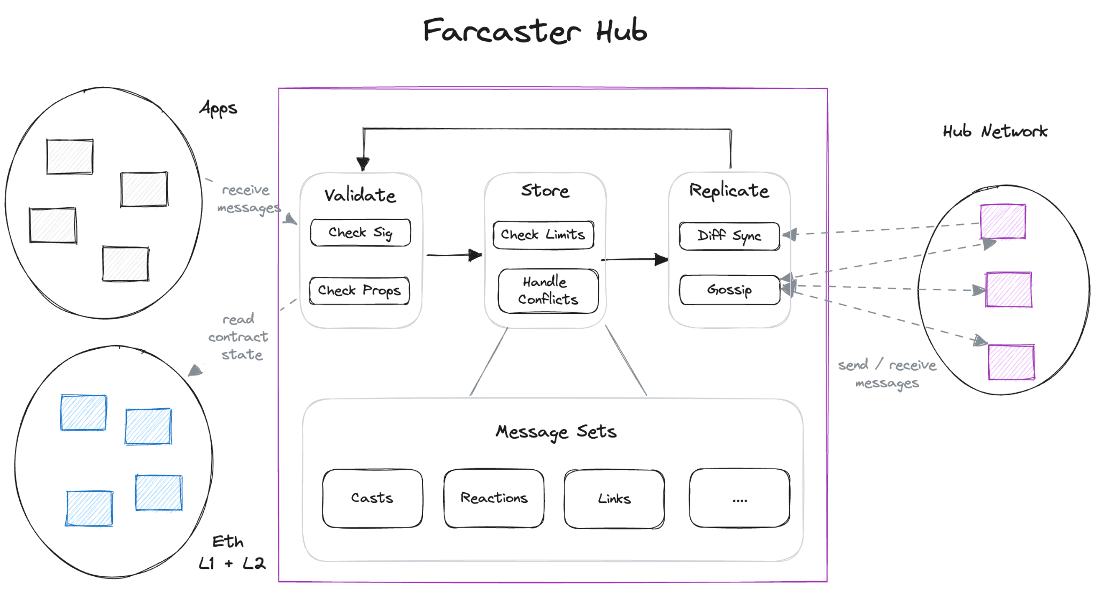
- Hubs are peer-to-peer nodes that store, validate, and replicate messages to ensure consistency across the network.
- Instead of relying on blockchain consensus, Farcaster uses deltagraph, a model that structures user data as CRDT-based deltas rather than transactions.
- Deltas represent atomic changes (e.g., adding or removing a post) and are stored, forwarded, and merged asynchronously across Hubs.
Solving the Goldilocks Consensus Problem with Deltagraphs
Traditional decentralized architectures face a fundamental tradeoff:Federated models allow independent servers but often lead to API fragmentation and oligopolistic control.
- Blockchain-based models ensure strong consistency but are too slow and expensive for high-throughput applications.
Farcaster introduces deltagraphs, a hybrid model blending blockchains for security and CRDTs for decentralized state synchronization. Unlike blockchain consensus, which requires strict transaction ordering, deltagraphs allow nodes to reach local consensus independently, requiring only minimal coordination for identity management and resource allocation.
Deltagraphs & CRDT-Based Conflict Resolution
A deltagraph is a CRDT-based structure where deltas (atomic units of change) represent social interactions. Each delta is independently verifiable, meaning nodes can accept or reject updates without requiring a central coordinator.
- CRDTs enable eventual consistency by allowing nodes to store and process updates in any order.
- Local state reconciliation is deterministic—even if updates arrive in different sequences, nodes applying the same rules will always converge to the same final state.
- Remove-Wins Rule: If a delete delta arrives before an add delta, the system ensures that the post remains deleted, preventing inconsistencies such as reappearing ghost posts.
For example, if Alice posts “Hello World” and later deletes it, nodes receiving the delete before the add will still converge to the correct final state. Unlike blockchains, where transaction order affects outcomes, deltagraphs allow independent operations while ensuring eventual consistency.
Message Synchronization: Combining Gossip Protocol & Diff Sync
Efficient state propagation across a decentralized network is critical for maintaining a seamless user experience. Farcaster employs a two-step synchronization process to ensure fast and reliable message delivery:
1. Gossip-Based Propagation (Fast, But Lossy)
- Every Hub maintains a UDP-based gossip channel with other known Hubs.
- When a new message (delta) is created, it is immediately broadcasted to connected peers using libp2p’s GossipSub protocol.
- This enables low-latency dissemination, ensuring that messages appear in real-time across applications.
- Downside: Gossip is inherently lossy—messages may fail to reach all Hubs, leading to potential inconsistencies.
2. Diff Sync (Accurate, But Slower)
- Since gossip can drop messages, Hubs periodically perform an out-of-band synchronization process called Diff Sync.
- Each Hub maintains a Merkle tree representation of its stored messages, allowing them to efficiently compare states with peers.
- If discrepancies are found, the missing messages are pulled via a TCP-based request, ensuring a full and reliable sync.
- Diff Sync is resource-intensive and runs less frequently (e.g., once per minute vs. gossip, which happens continuously).
This hybrid synchronization mechanism ensures that:
- Most updates propagate instantly via gossip.
- Missing updates are recovered via periodic Diff Sync.
- Nodes remain resilient to temporary network failures.
When a new Hub joins the network, it:
- Connects to at least one existing Hub.
- Bootstraps its state by gossiping with peers.
- Performs an immediate full Diff Sync to catch up with the latest network state.
Storage Management & Rent-Based Expiry
A key challenge for decentralized networks is preventing unbounded data growth. Without limits, a malicious actor could spam the network with billions of messages, causing Hubs to crash due to storage exhaustion.
Farcaster mitigates this by implementing rent-based storage:
- Users pay a storage fee to retain their messages for a fixed duration (e.g., one year).
- Each user is allocated a fixed number of storage units.
- If a user exceeds their storage limit, older messages are automatically pruned using a last-write-wins rule.
Since deltagraphs do not have built-in financial transactions, rent payments are handled on-chain via Ethereum:
- Users register their Farcaster ID (FID) and pay rent on Optimism.
- Off-chain deltas are signed using their wallet key and submitted to Hubs.
- The deltagraph verifies rent payments before accepting messages.
This mechanism prevents storage bloat while ensuring that users can extend their history if needed. Since older messages naturally expire, data pruning is deterministic, keeping the system scalable.
Project 3- DefraDB
DefraDB is a decentralized, peer-to-peer database designed for user-centric applications, leveraging Conflict-free Replicated Data Types (CRDTs) and IPLD (InterPlanetary Linked Data) to ensure seamless data synchronization across distributed nodes. Built on a local-first paradigm, DefraDB enables applications to maintain data integrity without centralized servers, preserving user sovereignty and offline functionality. By integrating advanced CRDTs, Merkle DAGs, and a multi-write-master architecture, DefraDB empowers developers to create robust distributed systems that automatically reconcile conflicts in concurrent data modifications.
CRDTs in DefraDB
At the core of DefraDB’s architecture is Merkle CRDTs, an innovation that enhances traditional CRDTs by embedding them within a Merkle Clock system. This approach ensures deterministic, conflict-free synchronization of data across distributed peers. CRDTs in DefraDB are designed to:
- Enable Multi-Device Synchronization: Applications leveraging DefraDB can operate offline, with changes propagating seamlessly when devices reconnect.
- Resolve Conflicts Deterministically: Updates from multiple peers are automatically merged using CRDT semantics, preventing data loss or overwrite issues.
- Support Immutable and Verifiable State Tracking: Through Merkle DAG structures, every state change is cryptographically linked, ensuring data integrity and tamper resistance.
Applications of CRDTs in DefraDB
- Decentralized Collaboration Tools: By leveraging CRDTs, DefraDB enables real-time, conflict-free editing in collaborative applications such as document editors, note-taking apps, and shared whiteboards.
- Local-First Databases: Applications built on DefraDB can function without a persistent internet connection, making it ideal for decentralized social media, peer-to-peer messaging, and privacy-focused applications.
- Blockchain and Web3 Integration: DefraDB’s CRDT-based data model allows blockchain applications to efficiently manage off-chain storage, reducing on-chain transaction costs while maintaining strong consistency guarantees.
- Distributed AI & Knowledge Graphs: DefraDB can facilitate decentralized AI training datasets by ensuring consistent data replication across research nodes without requiring a central coordinator.
How CRDTs Work in DefraDB
- Merkle Clock for Causal Ordering: Unlike traditional CRDTs that rely on vector clocks, DefraDB embeds state changes in a Merkle DAG, providing a verifiable ordering of updates.
- Delta-State CRDTs for Efficient Synchronization: DefraDB employs delta-state CRDTs, allowing nodes to exchange only the minimal necessary updates rather than entire state snapshots, optimizing network bandwidth.
- Branching and Merging Mechanism: When updates occur independently on different nodes, DefraDB tracks divergent states and later merges them without conflicts, similar to Git-style version control.
Conclusion
DefraDB demonstrates how CRDTs can be leveraged to power decentralized, trustless data management in modern applications. By combining CRDTs with cryptographic structures like Merkle DAGs and IPLD, DefraDB enables a resilient, distributed database system that guarantees data consistency, privacy, and efficiency across a peer-to-peer network. This makes it a promising technology for the next generation of decentralized applications, where local-first data sovereignty and offline functionality are paramount.
Project 4 - OrbitDB: A Merkle-CRDT-Based Peer-to-Peer Database
OrbitDB is a serverless, distributed, peer-to-peer database built for the decentralized web. At its core, it uses Merkle-CRDTs, combining the append-only, verifiable structure of Merkle-DAGs with the causally consistent properties of CRDTs. This combination allows OrbitDB to offer an eventually consistent database system that doesn't require consensus or central coordination.
OrbitDB runs on top of IPFS for storage and uses Libp2p PubSub for replication and messaging, syncing data automatically among peers. It is especially suitable for dApps, local-first applications, blockchain protocols, and other systems that need to operate offline or in partially connected environments.
OrbitDB supports multiple data models, each built on top of its operation-based CRDT called OpLog:
- eventlog: An append-only log ideal for tracking ordered events.
- keyvalue: A simple key-value store.
- documents: A document store that supports querying by keys.
- keyvalue-indexed: A key-value store indexed using LevelDB.
Each of these models benefits from CRDT properties—automatic conflict resolution, immutability, and eventual consistency—enabled by embedding updates as cryptographically signed entries within a Merkle-DAG.
OrbitDB's modular architecture allows developers to build custom CRDT-based data structures using the same foundations.
Looking Ahead: OrbitDB's Future
As of 2025, OrbitDB is focused on enhancing robustness and expanding its ecosystem. Notable initiatives include:
- Encryption for entries and payloads to strengthen privacy.
- Mission Control, a GUI for managing OrbitDB instances.
- Ongoing development of Voyager, a persistent peer for replicating and hosting OrbitDB databases when the original peer is offline.
- Improvements to the sync protocol to better handle reconnects and intermittent networks.
OrbitDB is an open-source project, sustained by its developer community and funded through donations. Its growing ecosystem, combined with the robustness of Merkle-CRDTs, makes it a prime example of how CRDTs can power resilient, decentralized systems in real-world use cases.
As CRDT adoption continues to rise, projects like OrbitDB highlight the potential for peer-to-peer applications to scale globally without sacrificing consistency or decentralization.
Project 5 - Delta Network
Delta Network: A CRDT-Driven, Leaderless Blockchain Framework
Delta Protocol introduces a fundamentally new approach to blockchain design by removing centralized leaders from consensus and leveraging Conflict-Free Replicated Data Types (CRDTs) to ensure efficient, scalable, and trustless coordination across its network. Instead of following traditional blockchains that rely on total transaction ordering and bridging layers for interoperability, Delta establishes a network of independent domains that interact seamlessly under a shared global state.
CRDTs in Delta: Enabling Order-Independent State Synchronization
CRDTs are at the core of Delta’s state model, ensuring that changes (state updates) can be applied independently, without conflicts, and still reach the same final state. Unlike traditional blockchains that require strict transaction sequencing for global consistency, Delta’s model allows state changes to be processed in parallel across different domains while maintaining integrity.
- State Diff Lists (SDLs) as CRDTs
- Delta replaces direct transaction execution at the base layer with **State Diff Lists (SDLs)**—which are essentially compact representations of net state changes rather than raw transactions.
- Each SDL records only the essential modifications to the network’s state (e.g., balance updates) rather than full transaction details.
- Since SDLs only add or subtract values from the global state without creating conflicts, they behave like CRDT-based state updates—where the final global state remains the same regardless of the processing order.
- Asymmetric Spending and Ordering
- Delta ensures that spending transactions must originate from a user's associated domain, but users can receive funds from any domain. This loosens strict ordering constraints since the protocol only needs to verify that state updates remain valid rather than enforcing a single sequence for transaction execution.
- The only global consistency rule is that no SDL can reduce a user’s balance below zero, preventing double spending.
- Partial Ordering via Directed Acyclic Graph (DAG)
- Instead of a linear ledger, Delta organizes SDLs in a DAG structure, where dependencies are explicitly recorded rather than imposed via total ordering.
- SDLs from the same domain are totally ordered, while SDLs from different domains follow a partial ordering determined by their dependency relations.
- This approach ensures that execution across domains remains conflict-free, even without synchronizing all transactions across the entire network.
Gossip Protocol in Delta: Byzantine Reliable Broadcast (BRB)
Delta also eliminates the need for traditional global consensus protocols, replacing them with **Byzantine Reliable Broadcast (BRB)**—a gossip-based mechanism that ensures transaction propagation without requiring all validators to agree on an ordered list of transactions.
- Gossip-Based Dissemination of SDLs
- Instead of using Proof-of-Work (PoW) or leader-based consensus (PoS, BFT) to order transactions, Delta’s domains independently execute transactions and generate SDLs.
- These SDLs are gossiped across the validator network using Byzantine Reliable Broadcast (BRB), ensuring fast, consistent propagation without the need for a central sequencer.
- Reducing Consensus Complexity with BRB
- Traditional blockchains enforce global ordering, which requires costly leader-election mechanisms and creates bottlenecks.
- Delta removes this ordering requirement, allowing validators to agree only on the set of valid SDLs, not their specific sequence.
- The lack of ordering constraints enables validators to process multiple SDLs simultaneously, effectively achieving parallelized consensus.
- Ensuring Byzantine Fault Tolerance (BFT) Without Leader-Based Ordering
- By relying on BRB instead of consensus rounds, Delta ensures that every validator receives the same set of SDLs, preventing double-spending or conflicting state updates.
- Because SDLs inherently do not conflict with each other (due to CRDT-like properties), they can be applied in any order, maintaining network security while reducing computational overhead.
Why Delta’s Model is a Paradigm Shift
Delta’s approach fundamentally challenges the traditional blockchain trilemma—which posits that blockchains must trade off scalability, security, and decentralization. By leveraging CRDTs and gossip-based validation, Delta achieves:
- Scalability → Leaderless, parallelized processing of transactions across domains.
- Security → ZK-based state verification ensures correctness without needing global transaction execution.
- Decentralization → Validators do not require ordering consensus, reducing the risk of centralization in validator roles.
Project 6 - IPFS Collaborative Editing: CRDTs for Decentralized Real-Time Text Editors
Another compelling CRDT-powered project is IPFS CRDT Shared Editing, a decentralized, serverless real-time collaborative text editor that brings Google Docs-style functionality to the browser—without needing centralized infrastructure.
The project combines js-IPFS, PubSub, and CRDTs to allow peers to edit shared documents simultaneously. js-IPFS enables in-browser and Node.js operation, while IPFS PubSub broadcasts document updates across a topic. Since PubSub does not guarantee message order or delivery, CRDTs ensure convergence across all nodes without conflicts.
Each change to the document is embedded in a Merkle-DAG node, and updates are propagated by sharing the CID (Content Identifier) of the latest root node. This forms a self-verifying structure that captures the full edit history, enabling peers to reconstruct state efficiently. Merkle-CRDTs also handle message loss and offline edits gracefully—when a peer reconnects, it simply syncs the missing parts of the DAG.
Projects like this showcase:
- Conflict-free editing in real time
- Offline resilience and reconnection recovery
- Truly serverless collaboration using IPFS and CRDTs
Although the system trades off compaction and adversarial protections, it offers a highly usable foundation for decentralized productivity apps. Its use of Yjs, a CRDT implementation, alongside custom sync logic, makes it a flexible and extensible architecture for developers.
This project demonstrates how CRDTs, when combined with IPFS and Merkle-DAGs, can be applied to more interactive and stateful use cases—like text editing, media sharing, or knowledge curation—ushering in a new era of decentralized, local-first applications on the web.
Conclusion
Delta Protocol represents an evolutionary step in blockchain architecture by removing leader-based consensus, embracing CRDTs, and utilizing a gossip-based BRB mechanism for transaction verification. This enables a highly scalable and efficient system where state consistency is achieved without ordering constraints, making Delta an ideal platform for future decentralized applications requiring low-latency execution, cross-domain interoperability, and privacy-preserving computation.
Latest writing
Get In Touch
If you have thoughts, project updates, or feedback to share, please reach out via email. We encourage all submissions to include a detailed description and the latest developments.
general@velocity.capital